

FC Bayern could not manage more than a 0-0 draw at FC Schalke 04. FCBinside offers three takeaways from the first scoreless draw of the new Bundesliga season.
The Munich team dropped points against the promoted side for the first time this Bundesliga season. The match yielded the following insights:
1. Bayern’s roster strategy fails its first stress test
Vincent Kompany surprised everyone at Schalke with his lineup. Harry Kane and Michael Olise started on the bench, and Jamal Musiala was also held back for his comeback. Instead, Ismael Saibari started as the center forward, Nathaniel Brown at the “10” position, and Lennart Karl on the right wing.
The experiment didn’t really pay off. While Brown had one good chance and set up Luis Diaz with a strong pass, he remained largely inconspicuous overall. Saibari, filling in for Kane, barely made an impact, and Karl also posed little threat.
Kompany reacted: Kane came on at halftime, followed by Olise and Musiala in the 57th minute. With Olise in particular, Munich’s offensive play immediately became more dangerous and creative.
This is also interesting from a squad-planning perspective: Bayern deliberately entered the season with a relatively small professional roster. Young players are supposed to get their chances, and the club’s management is also banking on the versatility of players like Brown and Saibari.
After just one draw, there’s no need to fundamentally question this strategy just yet. Especially since Musiala has only just returned and talents like Karl still need time to get back to form after their injuries. The Schalke game, however, highlights a potential risk: if several key players are rested at the same time, the team’s quality could quickly decline.



In a long season, Kompany needs to be able to rest Kane, Olise, and the rest of the squad from time to time. The 0-0 draw at Schalke should therefore serve as an early warning sign for Bayern.
2. Diaz poses a real problem for Kompany
Luis Diaz could have—and, in fact, should have—decided the match at Schalke for Bayern. Shortly before halftime, the Colombian found himself alone in front of Loris Karius after a strong pass from Brown, but failed to connect properly with the ball. After the break, Davies sent him alone toward the Schalke goal once again. This time, Diaz’s attempt to chip the ball over Karius failed.
Manuel Neuer warned after the game: “We weren’t efficient and didn’t capitalize on our big chances.”
Diaz had trouble converting chances right from the start of his time at FC Bayern. Later, he got a much better handle on it and developed into one of the most important players in Kompany’s offense. However, the 29-year-old hasn’t quite found his footing yet this season.
Another question arises regarding Diaz: Is he lacking freshness right now? The Colombian is still feeling the effects of an extremely long previous season and is one of the Bayern players who is practically always on the field.
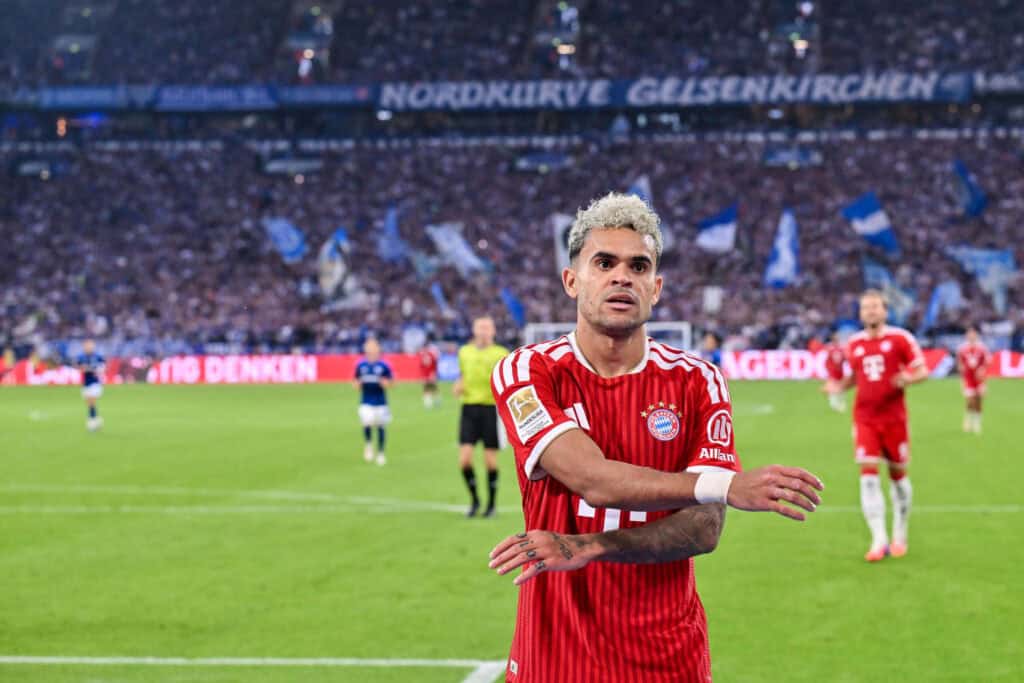
It could become a problem, however, that Kompany doesn’t have a true one-to-one replacement for Diaz. Arijon Ibrahimovic was actually intended to serve as backup on the left wing, but shortly before the transfer window closed, he was loaned to FC Augsburg. Instead, players like Karl and Saibari are expected to step in flexibly on the offensive end.
But if Diaz does indeed need a break or struggles to find his form for an extended period, the lack of a classic replacement on the left wing could become noticeable. In the long run, this could develop into a real problem for Kompany.
3. Schalke’s performance should serve as a warning to Bayern
A comment by Jonathan Tah after the game caught everyone’s attention. Referring to Schalke’s defensive approach, he explained: “To be honest, we expected something different.”
That’s surprising. After all, Schalke essentially did exactly what many teams try to do against FC Bayern: sit deep, close down the spaces, and give the individually superior Munich players as little room as possible. Especially from a newly promoted team, one could hardly expect them to play an open game against Bayern.
What was particularly notable, however, was how Schalke executed this plan. Miron Muslic’s team was tenacious, aggressive, and physically dominant. They consistently went into tackles and were prepared to work hard in defense for the full 90 minutes.
Muslic emphasized exactly that afterward: “This mentality, this attitude, this willingness to suffer, and at the same time this resilience—we showed all of that today.”
Bayern hasn’t always faced this kind of resistance in the Bundesliga recently. Before the 5-1 win over Stuttgart, for example, VfB striker Deniz Undav had described the matchup with the record champions as a “bonus game.”
Schalke, on the other hand, took on the challenge with their frenetic fans behind them and didn’t hesitate to play rough at times. The fact that this approach worked should serve as a warning to Bayern.
Other Bundesliga teams will have seen how Schalke caused problems for the Munich side with its intensity. The deep defensive block is nothing new for Kompany’s team. But Bayern will have to find better solutions in the future against this combination of compact defense, aggressiveness, and passion.