

FC Bayern impresses with defensive stability and teamwork in a 2-0 win in Madrid. Lennart Karl seizes his opportunity—and once again provides plenty to talk about.
FC Bayern wins 2-0 at Atlético Madrid on Matchday 4 of the Champions League. FCBinside offers three takeaways from the game.
1. Bayern displays a strength that has been missing recently
Against Borussia Dortmund, Bayern had led twice but still dropped two points. In Madrid, they confidently held on to their lead until the final whistle. Even after falling behind, Atlético could barely find a way to put serious pressure on the Munich side. For the first time in seven competitive matches in which they had conceded at least one goal, they kept a clean sheet.
This was due less to spectacular saves by Manuel Neuer than to the work done in front of him. Bayern pressed early, closed down space consistently, and gave the hosts little time to build up their attacks in an organized manner. They also defended long passes with great confidence. As a result, Neuer had very little to do on his return.
Dayot Upamecano, in particular, embodied this determination. The Frenchman won key duels and repeatedly joined in on the attacks. Before halftime, he set up a good chance for Lennart Karl with a run forward. Later, his deflected shot that hit the crossbar came very close to becoming a goal of his own.
Konrad Laimer also combined reliability in defense with impact on the attack. He set up a dangerous chance for Harry Kane and scored the 2-0 goal himself. The fact that Atlético marked Michael Olise closely opened up space for the player behind him, which the Austrian consistently exploited. Laimer and Upamecano each earned an FCBinside rating of 1.
The defensive stability was nonetheless a team effort. Josip Stanisic secured his flank, Joshua Kimmich and Tom Bischof contributed in the center, and the attackers pressed high up the field well before their own penalty area. Despite some isolated moments of uncertainty from Jonathan Tah, Bayern defended so cohesively overall that their lead was never seriously threatened. It was precisely this defensive solidity that had been missing recently.


2. Team cohesion is what sets Bayern apart
The personnel issues hadn’t disappeared by kickoff. Alphonso Davies once again stepped in on the left wing, and Bischof replaced Aleksandar Pavlovic, who was rested as a precaution. Olise remained below his usual level of impact following his knee problems. Kane also failed to score.
The fact that Bayern still won convincingly makes this performance particularly valuable. The team didn’t need an outstanding night from its two offensive stars to prevail against Atlético. Kane set up the second goal, and Davies won a crucial tackle leading up to the opening goal. Everyone was able to contribute, even if not everything went perfectly on offense.
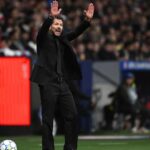
Aaron Danks played a part in that. The stand-in for the ailing Vincent Kompany stuck to the game plan and maintained the team’s attacking intent. His team seemed confident that they could get the job done with the players available. The victory in Madrid also speaks to the effective collaboration within the coaching staff.
Bischof described just how close-knit the players are after the game. Serge Gnabry and Ismael Saibari had texted him immediately after the final whistle. “The guys are watching from home, and I’ve already said that we’re not just playing for ourselves, but for them too,” the midfielder explained.
In the long run, this team spirit can’t replace injured key players. But it helps the team get through this difficult phase. Whoever steps into the lineup or has to fill in at an unfamiliar position receives support. Especially without Kompany on the sidelines, that’s a crucial foundation.
3. Karl gives the right answer—and causes a stir
At first, it wasn’t an easy evening for Karl. Playing as the number 10, he rarely found a way past Atlético’s tightly packed defense before halftime. He failed to capitalize on a good scoring opportunity, sending his shot well over the goal. But the 18-year-old didn’t let that discourage him.
In the 54th minute, he put pressure on Robin Le Normand in the penalty area, won the ball, and beat Jan Oblak with a delicate chip. Perseverance and technical skill came together in that moment. Karl remained alert and struck when the opportunity presented itself.
This goal was hugely important for Bayern. Despite their dominance, they hadn’t been able to break through Atlético’s defense until then. Karl put Munich on the path to victory, making the most of the opportunity created by the many absences. Especially after his difficult first half, that deserves recognition.
The subsequent debate over his celebration was unnecessary. With the hand gestures next to his ears, Karl provided new fuel for the debate sparked by the public criticism from Uli Hoeneß and Max Eberl. It remains unconfirmed who the gesture—apparently intended as “blah-blah”—was directed at. Nevertheless, it was enough to spark new interpretations.
A more experienced player would likely have spared himself this self-inflicted fuss and simply let his goal speak for itself. Karl, however, is only 18. He shows emotion, has a mind of his own, and doesn’t let himself be swayed even during a difficult phase. This personality has been part of him from the very beginning.
The bottom line is this: Karl has been a decisive help to the team. His performance on the field deserves more attention than the next discussion about his celebration.