

In the 2-2 draw against Borussia Dortmund, FC Bayern had to cope with several personnel setbacks. Two offensive players—Ismael Saibari and Serge Gnabry—were injured in the first half alone. Nevertheless, interim coach Aaron Danks initially chose not to bring Lennart Karl into the game. After the Bundesliga classic, the Englishman explained his surprising decision.
Munich’s injury woes worsened against BVB within a matter of minutes. First, Saibari had to leave the field after a collision with Dortmund goalkeeper Gregor Kobel. Shortly thereafter, Gnabry also went down, complaining of muscle pain.
Although Karl, an attacking substitute, was available, Danks opted for other solutions. Nathaniel Brown replaced Saibari, while Josip Stanisic came on for Gnabry. The 18-year-old Karl, on the other hand, had to remain on the bench for the time being.
Danks explains: This is why Karl had to wait
After the final whistle, Danks was asked about his substitution decisions. A journalist wanted to know why Karl wasn’t brought on despite the early injuries and whether the youngster might not yet be ready for such a high-stakes match.
The Kompany representative strongly disagreed with this assessment. “Lennart Karl came into the game in the second half, so we definitely trust him in matches like this. He came on for Michael on the right wing and took on exactly the role he usually plays,” Danks explained.
In fact, Karl didn’t come on until the 85th minute, after Michael Olise had also been injured.
Danks attributed his earlier decisions primarily to tactical considerations. “In recent weeks, it had been a good option to play Alfonso Davies high up on the left wing, so that’s what we decided to do.”



In doing so, the Bayern coach relied on a strategy that had already proven successful in previous games.
Brown’s substitution, too, was not a spontaneous decision. “And Nathaniel Brown played in attacking midfield at the start of the year in the Super Cup in Dortmund against Dortmund, so we brought him on in that position.”
“Lenny is a top-class player.”
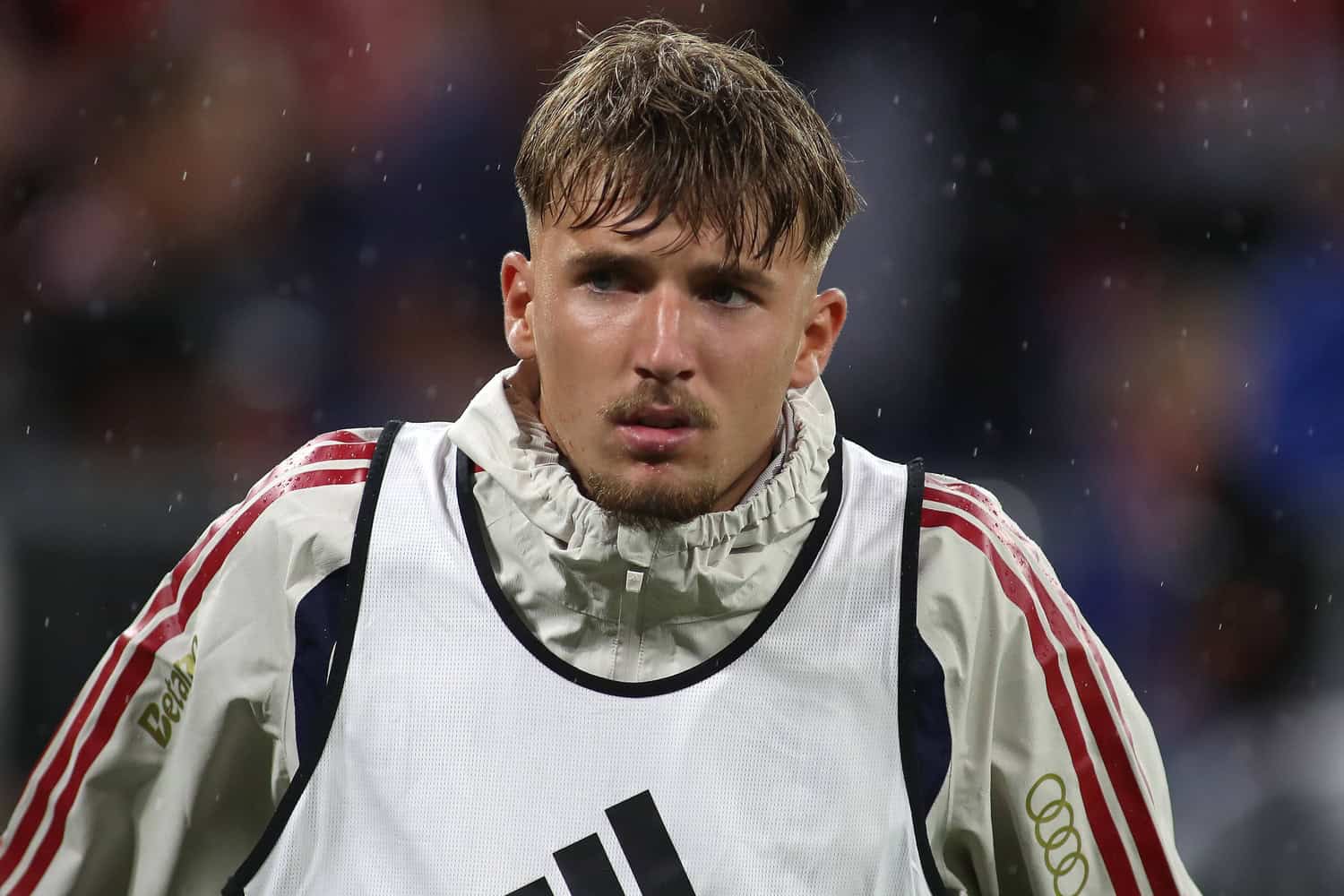
It was particularly important to Danks that his decision not be interpreted as criticism of Karl. “This isn’t a criticism of Lenny. Lenny is a top-class player; he came onto the field and had a great moment at the end when he hit the crossbar—that’s really positive for him.”
The 41-year-old was referring to stoppage time. In the fourth minute of stoppage time, Karl had hit the crossbar with a spectacular curling shot, nearly scoring the late winning goal.
Despite his limited playing time, the youngster proved that he can create dangerous attacking opportunities even in a top-level match.
For Karl, his coach’s praise is an important sign. After his injury-related break before the World Cup, the attacking player had recently shown his form on the rise again.
Given the current injury woes, his importance to the Munich team could now grow even further.
With Saibari, Gnabry, and Olise, three more attacking players are at risk of being sidelined. Jamal Musiala and Luis Díaz are also unavailable.
The next difficult challenge awaits as early as Tuesday with the Champions League away match at Atlético Madrid.
If the injured Bayern stars don’t recover in time, Karl could once again play a much bigger role in that match.