

Herbert Hainer has sparked a debate with his call for greater international involvement by Bundesliga clubs. Now Borussia Mönchengladbach is responding to the Bayern president’s remarks. While sports director Rouven Schröder does not fundamentally disagree with Hainer, he makes it clear that not every club has the same resources as FC Bayern.
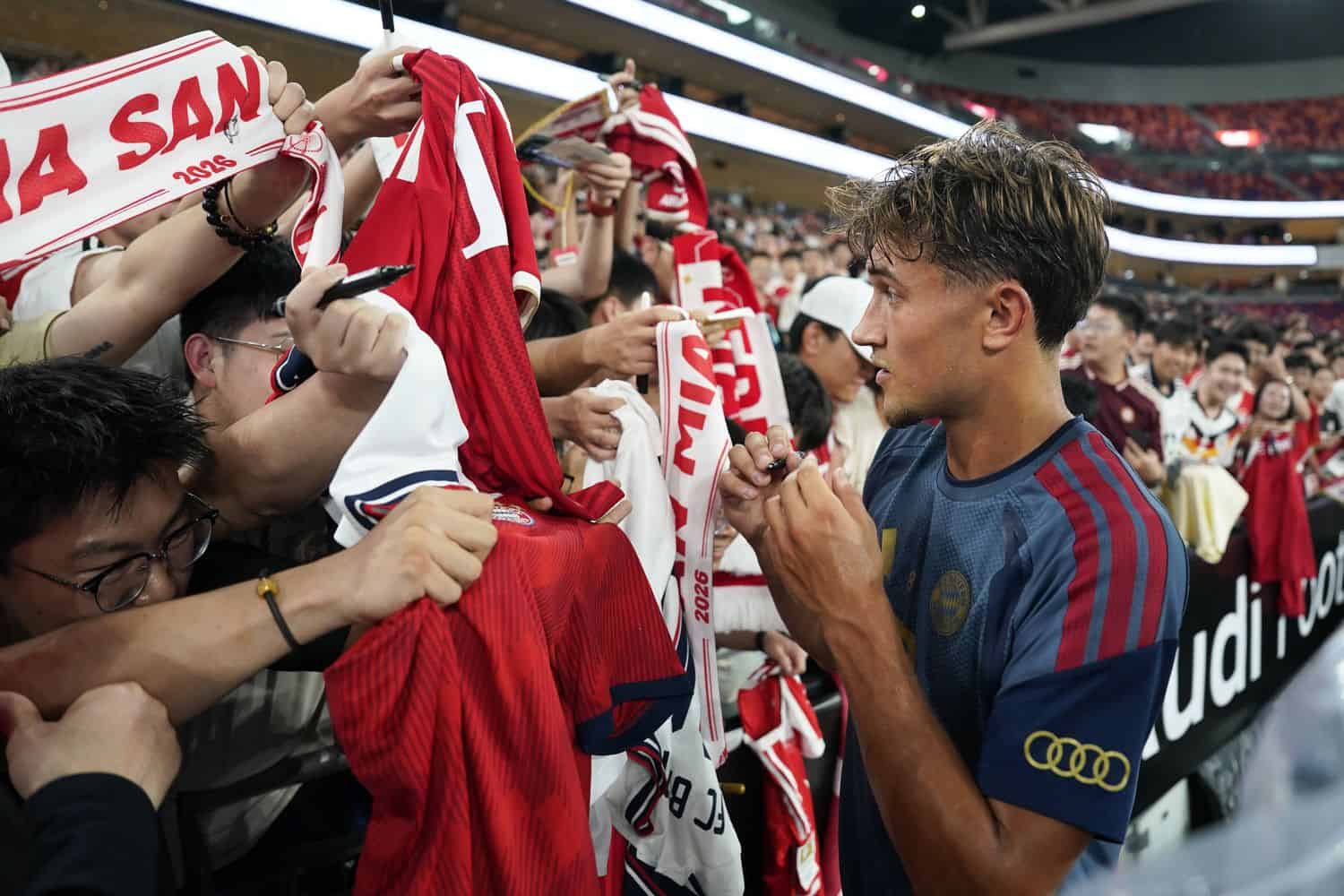
FC Bayern’s Audi Summer Tour through South Korea and Hong Kong was far more than just preseason training for the Munich club. Numerous sponsor events, public training sessions, and fan events were designed to further strengthen the German record champion’s brand in the Asian market.
For Bayern President Herbert Hainer, however, it is not enough for FCB alone to maintain an international presence. The 72-year-old has recently called on the Bundesliga’s competitors—and the league itself—on multiple occasions to become more active in international marketing.
“FC Bayern cannot be expected to shoulder the entire burden alone. We need much stronger support from the entire Bundesliga—not just from one or two clubs, but from the entire league,” Hainer explained.
The reason behind his call: Aside from Bayern, only a few German clubs are competing internationally this summer. Especially when compared to the Premier League, Hainer therefore continues to see a significant need for the Bundesliga to catch up in terms of global marketing.
Schröder: “I took it more as motivation”
Rouven Schröder has now commented on Hainer’s statements. However, Borussia Mönchengladbach’s sporting director did not want to interpret the Bayern president’s words as a direct attack on the other Bundesliga clubs.
“I didn’t perceive it as criticism at all, in that sense,” Schröder explained to Sport1 during Gladbach’s training camp at Lake Tegernsee.

At the same time, the 50-year-old made it clear that international travel isn’t equally feasible for every club. In addition to sporting considerations, economic and organizational factors also play a decisive role.
“Every club has to decide for itself. If the opportunities are there and it makes sense, then of course you look beyond your own backyard—that’s perfectly clear. So I saw it more as motivation,” Schröder emphasized.
The Gladbach boss is familiar with such marketing trips from his own career. “I’ve also gone on trips abroad with clubs during my career, so I know how it feels. It’s an exciting trip and has to work for everyone.”
Not every Bundesliga club has Bayern’s resources
In this regard, Schröder isn’t fundamentally contradicting the Bayern president. The Gladbach executive also sees added value in promoting German soccer more strongly outside of Europe. At the same time, he clearly puts Hainer’s demand into perspective.
After all, a trip lasting several days to Asia or the U.S. involves considerable effort. FC Bayern not only boasts one of the world’s best-known soccer brands, but also has well-established structures, partners, and a large fan base in international markets. For smaller Bundesliga clubs, therefore, the question of whether the economic and sporting benefits justify the effort is much more pressing.
This is precisely where differing perspectives clash. Hainer argues from the standpoint of the internationally oriented record champion and sees the Bundesliga as a whole as having a responsibility. Schröder, on the other hand, emphasizes the individual capabilities of each club.
It is undisputed that the Bundesliga faces a major challenge in international competition. The Premier League, in particular, has established itself as a global brand in recent years and is thereby generating enormous revenue.