
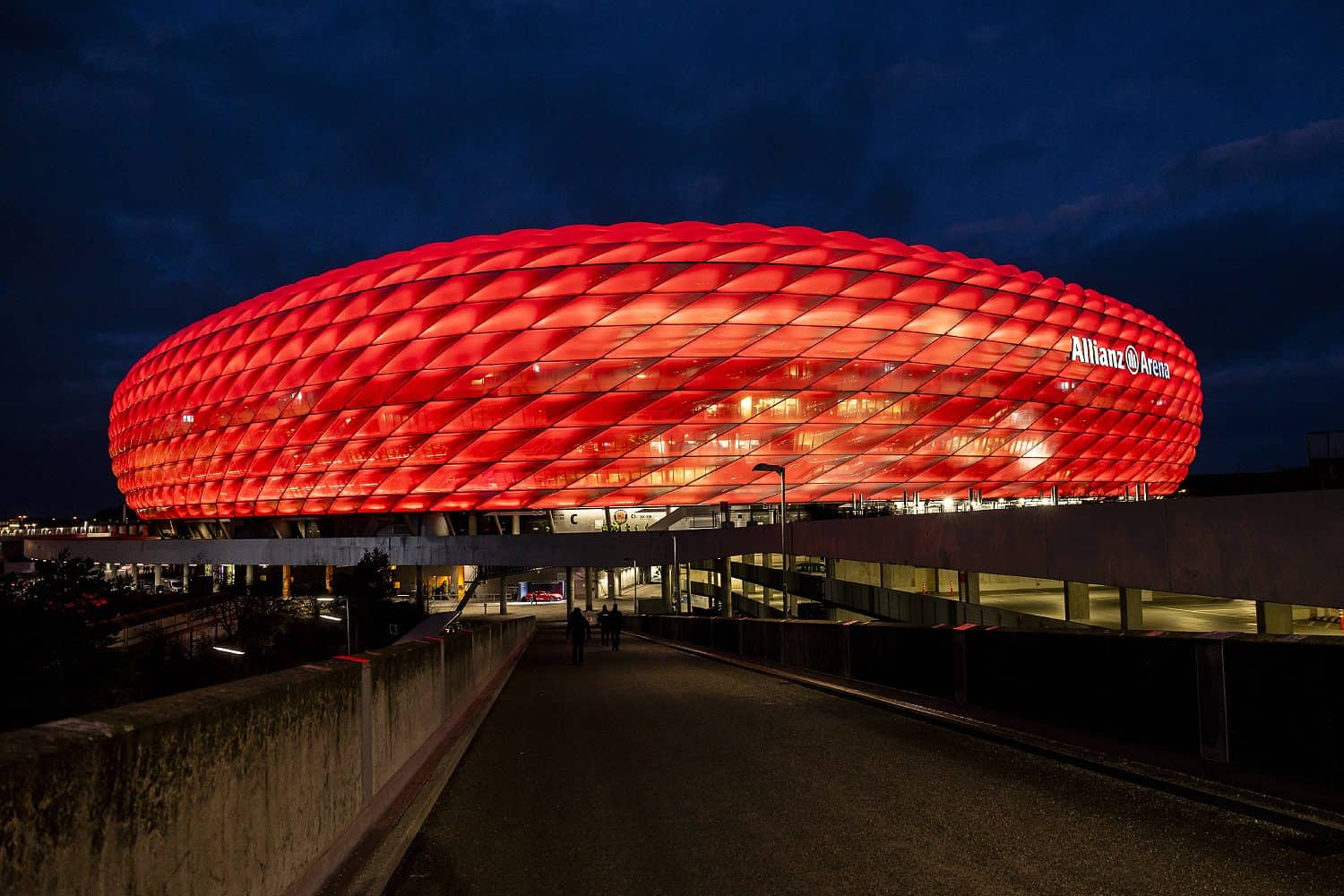
The Allianz Arena currently has a capacity of 75,024 seats for domestic matches. This figure applies primarily to FC Bayern Munich matches in the Bundesliga and German domestic competitions, when standing room is permitted. For international matches, the capacity is typically 70,000 seats, as standing-room-only sections are usually converted into seated areas or handled differently. According to the official Allianz Arena website, 75,024 seats are currently permitted for Champions League matches as part of a UEFA pilot project.
This makes the Allianz Arena one of the largest soccer stadiums in Germany. The stadium is particularly well-known not only for its capacity but also for its illuminated exterior shell, modern infrastructure, and close ties to FC Bayern Munich.
What exactly is the Allianz Arena’s capacity?
The Allianz Arena’s capacity is 75,024 seats for domestic matches. This figure includes seating, standing areas, business seats, VIP boxes, press areas, the visitors’ section, and accessible seating.
The international capacity is normally 70,000 spectators. The difference stems primarily from the regulations for international competitions, as pure standing-room-only sections are traditionally not used there as they are in the Bundesliga.
The current special regulation in the UEFA Champions League is important. Due to a UEFA pilot project, 75,024 seats are currently approved for Champions League matches as well, according to official arena information.
Allianz Arena Capacity for Bundesliga Matches
The Allianz Arena capacity for Bundesliga matches is 75,024 spectators. This figure is particularly relevant for FC Bayern Munich home games because the Bundesliga allows standing room.
The standing room is located primarily in the fan sections. The official arena lists a total of 13,342 standing room seats, of which 9,336 are in the South Stand and 4,006 in the North Stand.
The South Stand is the stadium’s most famous hub of excitement. Many active FC Bayern Munich fans stand there, which means the section contributes significantly to the atmosphere during home games.
Allianz Arena capacity for international matches
The Allianz Arena’s capacity for international matches is typically 70,000 spectators. This capacity applies when traditional standing-room-only sections are not permitted and international seating regulations are in effect.
The Champions League may differ. The Allianz Arena states that, due to a UEFA pilot project, 75,024 seats are currently authorized on Champions League match days.
The exact number of spectators may still vary depending on the match, security measures, media areas, UEFA regulations, or the closure of individual sections. Additional organizational requirements may apply for special matches, finals, or international tournaments.
Why does the capacity differ depending on the competition?
Allianz Arena capacity varies by competition because national and international soccer associations have different rules regarding standing room, security, media areas, and seat usage. In Germany, standing room is firmly established in league play, while international competitions have long been more focused on pure seating capacity.
The difference primarily affects the curved sections. When standing room is used, more fans can fit into certain sections. When these areas are converted to seating, the maximum capacity decreases.
Capacity is therefore not a single, fixed number. For most Bundesliga-related questions, 75,024 is the correct answer; for standard international comparisons, 70,000 is often cited.
How many standing room spots does the Allianz Arena have?
The Allianz Arena has a total of 13,342 standing room seats. These standing room seats are distributed across the South and North stands.
The South Stand has 9,336 standing room seats. The North Stand has 4,006 standing room seats.
Standing room is particularly important for the atmosphere in the stadium. It allows for a denser fan structure and is a central part of fan culture in German soccer.
How large is the visitors’ section at the Allianz Arena?
According to official figures, the Allianz Arena has a capacity of 7,500 away seats. The away section is reserved for fans of the visiting team and is organized depending on the match and security situation.
The visitors’ section plays a particularly important role during Bundesliga matches, DFB Cup matches, and international games. For high-risk matches or special fixtures, security measures may affect access points, routing, and section separation.
Exact availability for away fans always depends on the specific competition and the ticket allocation. Not every match fully utilizes the theoretical capacity of the away section.
How many VIP and business seats are there?
The Allianz Arena has a capacity of 2,152 business seats and 106 VIP boxes. These boxes can accommodate a total of 1,371 guests.
Business and VIP areas are an important economic component of modern stadiums. They offer better views, catering, separate entrances, and special lounge areas.
These seats are included in the total capacity. However, they are not comparable to regular grandstand seats because they are usually allocated through hospitality packages, corporate allocations, or special bookings.
How many accessible seats are there at the Allianz Arena?
The Allianz Arena’s capacity includes 324 special seats for people with disabilities. According to official information, these seats are located at the level of the main entrance or in the outdoor area at ground level, so no change in level is necessary.
Accessible stadium seats are important so that people with mobility impairments can attend games safely and comfortably. This includes good access, appropriate sightlines, and nearby service areas.
Booking these seats is typically done through special ticketing processes. For specific matches, fans should check the latest information from FC Bayern Munich or the Allianz Arena.
How many press seats does the Allianz Arena have?
The Allianz Arena’s capacity also includes media areas and press seats. The official arena lists a press club with approximately 300 to 350 seats, depending on the specific section.
Press seats are particularly important for Bundesliga, Champions League, and international matches. Journalists, commentators, photographers, and TV crews require their own workspaces, sightlines, and technical infrastructure.
For major international matches, media requirements can affect the stadium’s usable capacity. Additional camera positions, commentator booths, or technical zones can alter specific seating areas.
How long has the Allianz Arena been around?
The Allianz Arena’s capacity has evolved since the stadium’s opening. The official opening matches took place on May 30, 2005, featuring TSV 1860 Munich against 1. FC Nuremberg, and on May 31, 2005, featuring FC Bayern Munich against Germany.
The stadium was built as a modern soccer arena for Munich. Initially, it was used by FC Bayern Munich and TSV 1860 Munich; later, FC Bayern became the sole user and owner through its stadium company.
Today, the Allianz Arena is closely associated with FC Bayern Munich. TSV 1860 Munich no longer plays there as the home team.
Who owns the Allianz Arena?
The Allianz Arena is operated by Allianz Arena München Stadion GmbH, which, according to official statements, is a wholly owned subsidiary of FC Bayern München AG. TSV 1860 Munich was originally a shareholder but later withdrew from the ownership structure.
This ownership structure explains why the arena is now clearly perceived as the home stadium of FC Bayern Munich. In the past, the colored lighting was also designed to be red for Bayern and blue for 1860.
Today, the red lighting is particularly striking during FC Bayern home games. The outer shell remains one of the stadium’s most distinctive architectural features.
How large is the Allianz Arena in terms of construction?
The Allianz Arena’s capacity is made possible by its massive stadium structure. According to official figures, the stadium measures 258 meters x 227 meters x 52 meters and has 7 levels.
The total site area is 171,000 square meters. The arena itself covers an area of 37,600 square meters.
The size is not only relevant for spectator seating. It also accommodates luxury suites, business areas, catering spaces, media zones, a museum, fan shops, locker rooms, technical areas, and security zones.
How many parking spaces does the Allianz Arena have?
The Allianz Arena’s capacity is complemented by a large transportation infrastructure. The official arena lists 9,800 parking spaces in four four-story Esplanade parking garages, as well as additional parking areas in the stadium vicinity.
In addition, there are 150 disabled parking spaces, 130 of which are in P1 and 20 in the visitor parking area. A total of 350 parking spaces are available for buses.
The parking structure is crucial on match days. With more than 70,000 spectators, arrival, departure, walking routes, and security checks must be well organized.
How many restrooms, kiosks, and food service areas are there?
The Allianz Arena’s capacity requires extensive amenities within the stadium. According to official figures, the arena features 6,000 square meters of catering space, 32 kiosks, two fan restaurants each seating 1,000 people, and a bistro for 400 guests.
There are 1,121 restroom stalls. In addition, more than 750 screens are installed in the stadium.
This infrastructure is important because a sold-out stadium needs more than just plenty of seats. Spectators also need to be able to move around, eat, drink, find their way, and be catered to during halftime.
How close are the spectators to the field?
The Allianz Arena is designed so that spectators sit relatively close to the field. The official minimum distance from the field is 7.5 meters.
This proximity creates an intense atmosphere. Especially during top-tier matches, the arena feels loud, compact, and emotionally charged.
The playing field itself has the standard dimensions of 68 x 105 meters. The total area around the playing field is listed as 72 x 111 meters.
Why is the Allianz Arena considered particularly modern?
The Allianz Arena’s capacity is only part of what makes the stadium significant. The arena is also renowned for its exterior shell, lighting, sightlines, technology, and organization.
The facade and roof cover a total area of 66,500 square meters. The structure consists of 2,784 inflatable foil cushions that define its striking appearance.
The illuminated area covers 25,500 square meters. The LED technology can display many colors, making the arena a Munich landmark, especially at night.
Allianz Arena Capacity Compared to Other Stadiums
The Allianz Arena’s capacity ranks among the very top in Germany. With 75,024 seats, it significantly outnumbers many Bundesliga stadiums, and only a few arenas in Germany offer more or a similar number of seats.
Signal Iduna Park in Dortmund is larger, while many other well-known stadiums such as the Veltins-Arena, the Olympiastadion Berlin (when used by clubs), Deutsche Bank Park, or the MHP Arena have smaller capacities or capacities that vary depending on the event.
The Allianz Arena is particularly impressive because it combines high capacity with modern stadium technology. While many older stadiums have tradition, they lack the same compact soccer arena structure.
Can the Allianz Arena be expanded further?
The Allianz Arena’s capacity could theoretically only be expanded through structural modifications. In practice, however, an expansion is complex because structural integrity, emergency exits, traffic, resident concerns, safety concepts, UEFA regulations, and comfort standards must all be taken into account.
Simply increasing the number of spectators is not automatically a good idea. More seats also mean more strain on entrances, restrooms, concession stands, parking lots, subway connections, security services, and exit routes.
The current capacity of 75,024 spectators is therefore a balanced figure. It combines a large stadium size with efficient match-day operations.
Why is the Allianz Arena often sold out?
The Allianz Arena’s capacity is fully utilized for many of FC Bayern Munich’s home games. The club has a large fan base, significant sporting prestige, and hosts many top-tier national and international matches.
Bundesliga home games, Champions League matches, and showdowns against major opponents are particularly in demand. Tourists and soccer fans from abroad also visit the arena regularly.
Demand often exceeds the number of tickets available. That’s why membership, the official ticket shop, and the secondary market are important topics for many fans.
What is the capacity for concerts or events?
The Allianz Arena’s capacity for concerts or special events may differ from its soccer capacity. The stage, technical equipment, safety zones, interior layout, and viewing areas affect the maximum possible number of spectators.
For soccer matches, the capacity is clearly defined. For events, it is planned and approved on a case-by-case basis.
The exact event capacity should therefore always be checked for the specific event. A general figure would be less reliable here than for Bundesliga matches.
Allianz Arena and Vapes
For many visitors, the Allianz Arena remains a place where the match-day experience, travel, stadium rules, and personal preparation all come together. Those interested in lifestyle topics before or after a stadium visit can find more information about elfbar vape; however, inside the stadium itself, the Allianz Arena’s current house rules, smoking bans, and safety guidelines must always be observed.
Frequently Asked Questions About Allianz Arena Capacity
How many spectators can the Allianz Arena hold?
The Allianz Arena’s capacity for domestic matches is 75,024 spectators. For international matches, the regular capacity is 70,000 spectators, although 75,024 seats are currently approved for Champions League matches as part of a UEFA pilot project.
How many standing-room-only spots does the Allianz Arena have?
The Allianz Arena has a capacity of 13,342 standing-room-only seats. Of these, 9,336 are located in the South Stand and 4,006 in the North Stand.
How large is the visitors’ section at the Allianz Arena?
The Allianz Arena has a capacity of 7,500 away seats. These seats are reserved for fans of the visiting team.
Why does the Allianz Arena have fewer seats for international matches?
The Allianz Arena’s capacity is often lower for international matches because international competitions have different requirements for standing room, seating, media areas, and security zones. That is why a capacity of 70,000 is frequently cited for international matches.
Does the Allianz Arena have 75,024 seats for Champions League matches?
The Allianz Arena’s capacity for Champions League matches is currently 75,024 seats because, according to official arena information, a UEFA pilot project authorizes this number on Champions League match days.
How many VIP boxes are there in the Allianz Arena?
The Allianz Arena has 106 VIP boxes with seating for a total of 1,371 guests. In addition, there are 2,152 business seats.
When was the Allianz Arena opened?
The Allianz Arena opened in May 2005. The official opening matches took place on May 30, 2005, and May 31, 2005.
Who owns the Allianz Arena?
The Allianz Arena is part of FC Bayern Munich’s structure through Allianz Arena München Stadion GmbH. According to official arena information, the company is a wholly owned subsidiary of FC Bayern München AG.