
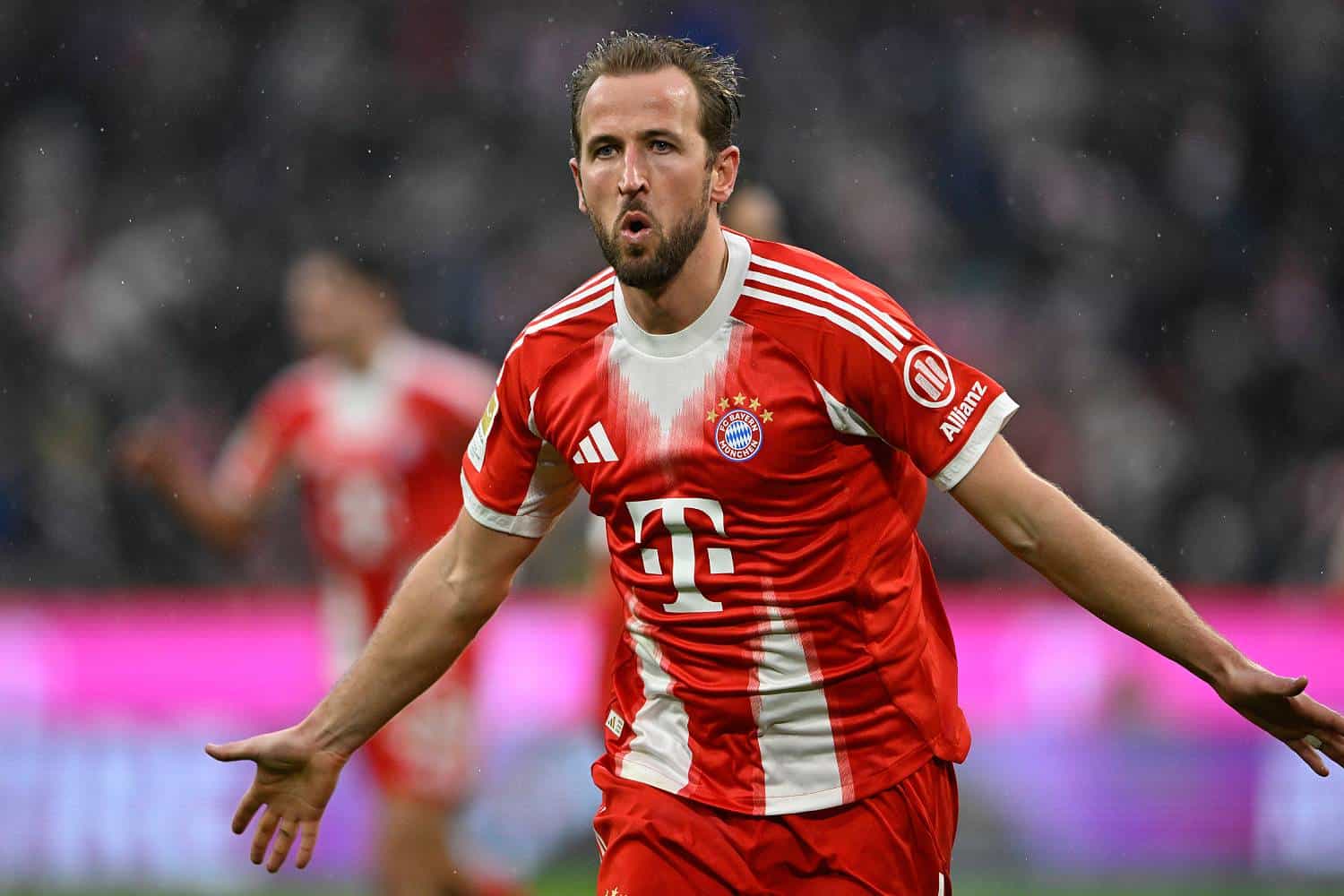
More and more of Bayern’s goals don’t start in the penalty area, but a few meters in front of it, where Harry Kane often takes the ball with his back to goal and looks for his passing partners. He not only looks for goals, he also makes his team capable of attacking
And this new role shifts the rhythm of Bayern’s attack. You hardly ever see the classic striker who only shoots from the penalty area with Kane this season
The finish after preparatory work
The pace of the game increases as soon as Bayern get the ball into the final line. Full-backs push forward, wingers move into the half-spaces and the penalty area becomes tighter
In such situations, Kane seems almost stoic: one touch, one finish
And this stoicism in Kane can be measured. According to the official Bundesliga statistics portal of the German Football League, Kane scored a total of 36 league goals in the 2023/24 season. No player had ever scored that many goals before him in his first Bundesliga season
This figure is by no means just a personal best for him, but it also shows just how much Bayern’s attacking play is still focused on a clear focal point
At the same time, however, many of Bayern’s attacks no longer only come into the penalty area via crosses or cross-ins. The way they get there has changed
Data changes the view of top games
The European Football Union published a remarkable figure in the UEFA Benchmarking Report 2024: UEFA Champions League matches reached more than 400 million viewers per match day worldwide in the 2023/24 season
This development also influences the way matches are analyzed. Platforms publish real-time data on passes, running routes and completion probabilities. Fan forums discuss match situations minutes after the final whistle
Almost all new sports betting providers now use similar data bases. They draw on live feeds from the major sports data companies, evaluate position data and build their odds models on this basis. What was once considered a marginal topic is now part of a broader information economy surrounding professional soccer
The analysis of a soccer match no longer ends with the final whistle. Moves are broken down into short clips, running routes are displayed as data sets. Even the smallest movements become visible
A striker looking for the play in midfield
Kane often moves to the exact spot where a playmaker used to be. Some scenes seem almost contradictory. The center forward runs back to the center circle while a winger makes a parallel run into the penalty area. A central defender is faced with the decision of whether to move out with the attacker or stay in the chain
Thomas Tuchel had already deliberately incorporated these movements into his attacking play. Under Vincent Kompany, this plan is holding up. The attacking play is based more on changing positions than on rehearsed running routes
This makes Bayern’s game more difficult to see through
The classic runs into the penalty area remain important, but they are less and less likely to lead to the quick route there. The attack now often plays itself free through the center
Bayern’s offense works in waves
The effect is particularly evident in the second attacking wave: as soon as Kane drops, midfielders move in
Jamal Musiala is one of the most important beneficiaries of this dynamic, with his dribbles often emerging from precisely these gaps
FC Bayern have several players who dribble into the penalty area from deep. These movements are rarely described as a tactical pattern in their own right, but can be observed regularly
The structure can be simplified
- Kane drops between midfield and attack
- Wingers start diagonal runs into the penalty area
- an eighth man pushes forward from the second line
The effect does not always occur, but often enough
A concrete example from the Bundesliga
The influence of such analyses can be observed particularly well in one match
In November 2024, FC Bayern faced Borussia Dortmund in the Bundesliga. The match quickly developed into an open game, with both teams pressing high up the pitch
In the 9th minute, Kane dropped back wide for the first time. The centre-back followed him. Musiala launched into the open space at the same time
The attack lasted just a few seconds, a typical scene
Such sequences appear spontaneous, but in fact they often arise from video analysis and training situations that have been prepared in the weeks beforehand
The tactical work behind these movements usually remains invisible to spectators
The historical dimension of Kane’s season
Bayern has a long tradition of exceptional center forwards. Gerd Müller shaped the role of the penalty area player in the 1970s. Robert Lewandowski dominated the Bundesliga for over a decade
Harry Kane brings a different interpretation. His goal tally is impressive, but it doesn’t tell the whole story. The Englishman often acts as a link player between midfield and attack
This changes the weight distribution in the game
The Bundesliga published another figure in the technical report for the 2023/24 season. FC Bayern scored 94 league goals this season. Some of these goals came from precisely those movements in which Kane was not even in the penalty area to begin with
The new dynamic in attacking play
The development of modern center forwards is not only evident in Munich. Many top European clubs are now looking for players who can fulfill multiple roles
The classic penalty area player remains important
But the modern striker has to do more, linking lines, keeping the ball under pressure and opening up spaces for other players
These requirements arise from a game that is becoming faster and faster
Possession phases last shorter, pressing structures take effect earlier and spaces are only created for seconds
A player like Kane can use these seconds.